The Carpool Outfit for a Freezing Car and an 80-Degree Pickup

Quick Answer: The September carpool problem is two different climates in one outfit - a cold car at 7:30am and a hot one at 3pm. Solve it with a fitted base you’d be happy in alone, one removable mid-layer that lives in the car rather than on you, and footwear you can drive in. The mistake is dressing for the temperature at departure; dress for the base layer you’ll be in by 3pm and keep the warmth removable.
You scrape frost off the windshield and by pickup it’s 81F with the sun straight through the side window.
Same outfit, both trips. It’s doable, and it’s mostly about what stays in the car.

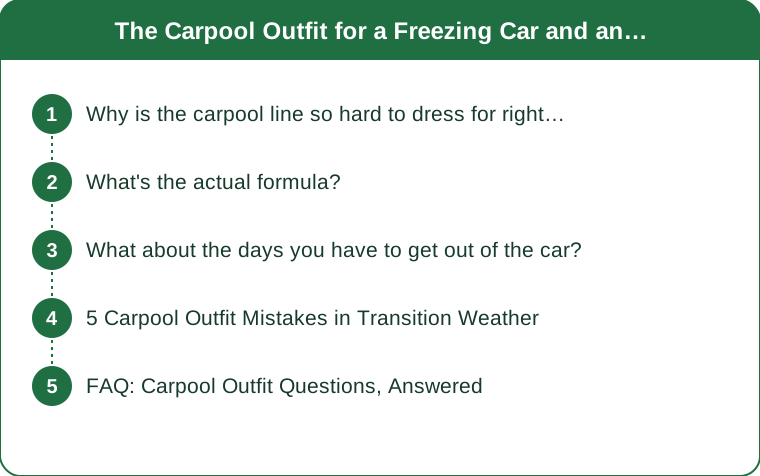
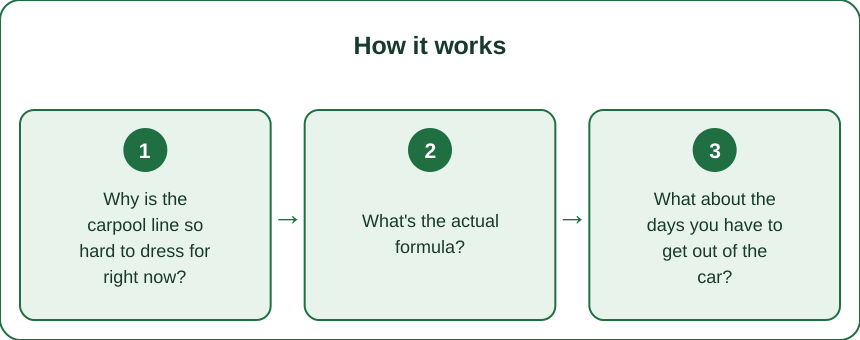
Why is the carpool line so hard to dress for right now?
Because you’re managing three microclimates, not one.
The cold car. A vehicle that sat outside overnight is colder than the air, and the heater doesn’t do much on a ten-minute drive. This is the coldest ten minutes of your day, and it’s where most people over-dress for the entire rest of it.
The outdoor stand. Two to five minutes on tarmac, often in wind, sometimes waiting longer than expected. Short but disproportionately memorable, which is why people overcompensate.
The afternoon greenhouse. A car in direct sun climbs dramatically above outside air temperature. The 3pm pickup is regularly the hottest environment you’ll be in all day, even on a mild afternoon.
So the outfit needs to work at roughly 50F and roughly 90F within eight hours, with almost no opportunity to change.
The key insight: you don’t dress for the cold morning. You dress for the afternoon and carry the morning’s warmth separately - because you can add a layer in a cold car and you cannot remove a thick sweater you’re wearing at 3pm without an actual change of clothes.
Sun exposure is the other factor nobody accounts for. The driver’s side gets sustained direct sun through glass on afternoon runs. Standard car windows filter most UVB and much less UVA, which is why sun protection on the left arm and face is a real consideration, not a fussy one.
What’s the actual formula?
Four components, one of which never gets worn.
1. The base you’d be happy in alone at 80F. A fitted tee, a tank with a cardigan option, or a short-sleeve knit. This is the outfit - everything else is temporary.
2. Bottoms that work in a hot car. Full-length leggings, straight-leg trousers, or a midi skirt. Avoid anything that sticks to a hot leather seat - a smooth-faced legging or a woven trouser beats a bare leg on a warm vinyl seat every time.
3. The car layer. This is the one that lives permanently in the car, not on your body. An oversized cardigan, a fleece, or a wrap in the back seat. You put it on for the morning run and leave it there.
4. Shoes you can drive in and stand in. Slip-on trainers, loafers, flat ankle boots. The pedal test is real - anything with a thick sole or a strap that catches is a genuine nuisance twice a day.
Why the car layer changes everything: carrying a jacket is annoying, and putting one on and off is fiddly. Leaving it in the car means you never carry it, never lose it, and it’s always there - including for the unplanned wait, the sports pickup, and the cold snap you didn’t check for.
Keep a small kit in the door pocket while you’re at it: sunglasses, a hair tie, lip balm, and a spare mask of sunscreen for the driving arm. Two minutes of setup, used daily for months.

What about the days you have to get out of the car?
The version that has to look put together, without changing.
Upgrade the base rather than adding a layer. A knit top or a simple shirt instead of a tee. The single-piece upgrade reads as effort and costs nothing in temperature management, which is the whole point.
One structured element does the heavy lifting. A structured bag, a proper shoe, or a belt. Structure is what separates an outfit from clothes, and one piece of it is enough.
The three-second rules for the get-out days:
- Tuck the front of the top. A front tuck defines the waist and takes a second
- Push sleeves to the elbow. Reads intentional rather than casual
- Sunglasses on the head, not in the bag. Genuinely does something for a thrown-together outfit
Anticipate which days those are and don’t optimise for the others. Most carpool days nobody sees you, and dressing every day for the two that matter is how people end up uncomfortable five days a week.
A specific autumn note: the school-event days start clustering in September - back to school nights, first games, meet the teacher. Have one outfit decided in advance for those, so it isn’t a 6pm decision after a full day.
5 Carpool Outfit Mistakes in Transition Weather
The ones that repeat every September.
1. Dressing for the 7:30am temperature. The most common by far. You spend twelve minutes in that temperature and eight hours in a warmer one. Dress for the day, carry the morning.
2. A heavy coat instead of a car layer. A coat is a nuisance to drive in, restricts arm movement at the wheel, and is far too warm indoors. A cardigan or fleece in the car does the same job with none of the problems.
3. Shoes chosen without the pedal in mind. Chunky soles, ankle straps, and anything backless make driving genuinely worse. Test any new shoe against a pedal before it becomes a carpool shoe.
4. Skipping sunscreen because it’s September. UVA levels stay meaningful well past summer and standard car glass doesn’t block much of it. The driving-side arm and the left side of the face take a cumulative dose across an entire school year.
5. Bare legs on a hot seat. Not a style issue - a comfort one. A car interior in the afternoon sun gets genuinely hot to the touch, and a full-length legging or trouser is more comfortable than shorts in exactly the situation where that seems backwards.
The pattern in all five: the outfit gets designed for the moment you leave the house, and the rest of the day pays for it.
FAQ: Carpool Outfit Questions, Answered
What single item makes the biggest difference?
An oversized cardigan or fleece that lives in the car. It solves the cold morning, the unexpected wait, and the evening game without ever being carried, and it costs nothing to implement.
How do I look pulled together without changing between the school run and work?
Upgrade the base layer rather than adding layers, and include one structured piece - a bag or a shoe. Both survive temperature changes, which a blazer doesn’t.
What shoes are actually best for driving?
Flat, flexible sole, secure at the heel. Slip-on trainers, loafers, and low ankle boots all work. Backless shoes and thick platform soles are the two categories worth avoiding entirely.
Do I need sunscreen for a ten-minute drive?
For a single drive, the dose is small. Twice daily across a school year is not small, and it lands on one arm and one side of the face. A moisturiser with SPF as part of the morning routine handles it without adding a step.
How do I handle rain in the pickup line?
A packable shell in the car alongside the warm layer, plus shoes that tolerate a wet car park. The combination that fails is a good coat and unsuitable shoes - wet feet ruin an afternoon far more effectively than a damp jacket.
TL;DR:
- You’re dressing for three microclimates: cold car, brief outdoor stand, and a hot afternoon car
- Dress for the afternoon and keep the warmth removable - you can add in a cold car, you can’t remove at 3pm
- Keep the warm layer permanently in the car so it’s never carried and never forgotten
- Choose shoes against the pedal, and avoid bare legs on hot afternoon seats
- Upgrade the base layer, not the number of layers, on days you have to get out
- Sunscreen matters: car glass filters little UVA, and it’s the same arm every day
The carpool outfit problem is really a car storage problem. Solve it once in the back seat.
See It in Motion
Seen here: High Waist Yoga Leggings with Side Pockets — shop it on bubblelime.com
Keep Reading
This article is for general informational and styling purposes only. Fit, sizing, and product availability may vary.