The Carpool Outfit for the Days You Actually Have to Get Out of the Car

Quick Answer: Build the outfit around the version where you get out - shoes you can walk in, a top that works without the jacket, and a bottom that does not look like pyjamas in daylight. The seated-only outfit fails roughly one morning in four, and it always fails on the morning you least want it to. One structured layer over an otherwise comfortable base solves it.
The car is a very forgiving environment. It hides your shoes, half your outfit, and all of your posture. The forecourt does none of that.

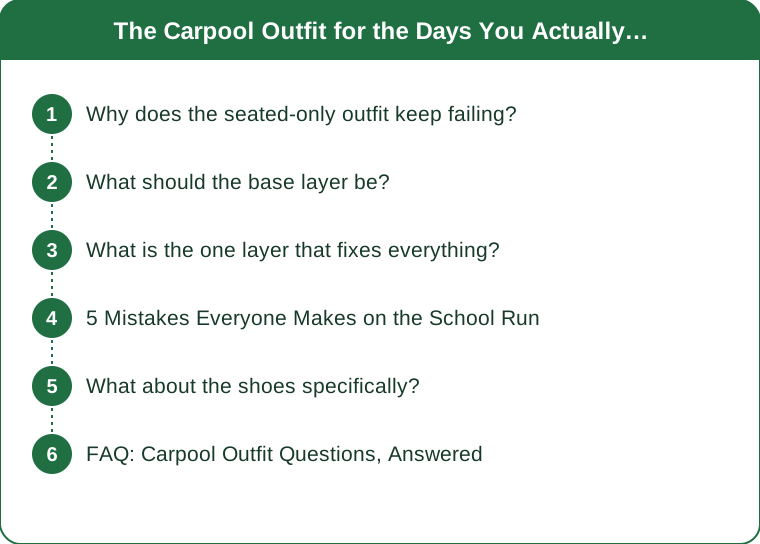
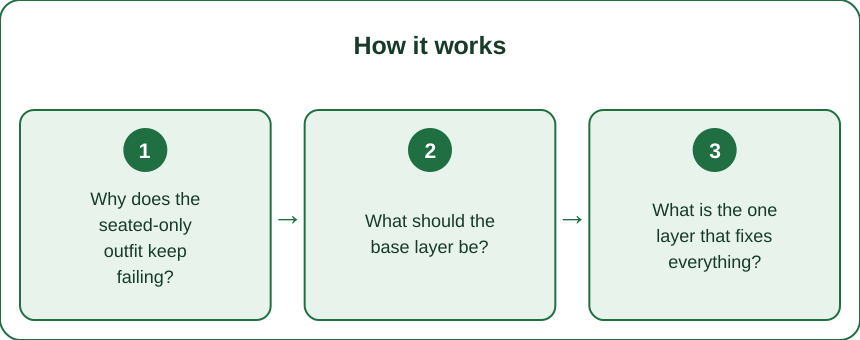
Why does the seated-only outfit keep failing?
Because getting out is not rare, it is just unplanned.
The situations that force it: a forgotten bag, a teacher who wants a word, a parking space that is nowhere near the gate, a child who will not go in alone, an unexpected errand on the way home, and the day the drop-off line is closed for works. Any given morning has maybe a one in four chance of one of these, which over a school week means it happens most weeks.
What the seated outfit hides. Sitting in a car, you are visible from roughly the shoulders up. Your shoes, your hem, your waistband, and how anything actually fits are all invisible. That is why outfits that feel fine in the driver seat feel wrong in a corridor.
The three things that give it away when you stand up:
- Shoes. Slides, slippers, and unlaced trainers are the top three, and they are what most people are wearing
- The bottom half. Sleep-adjacent leggings, pyjama bottoms, and anything with a drawstring that has gone slack
- The top layer, or its absence. A cotton tee alone reads as indoors. The same tee under a structured jacket reads as dressed
The design principle worth adopting: dress for the version where you get out, and let the seated version be comfortable by default. It costs nothing - the comfortable base stays exactly the same, and only the shoes and one layer change.
What should the base layer be?
Something you would be comfortable in for two hours and would not mind being seen in.
The specification:
- A bottom with a proper waistband - a legging with a wide flat waistband, a straight-leg jogger with a clean hem, or a jean you can genuinely sit in. Not a drawstring that has stretched out
- A top with a finished neckline. A ribbed long sleeve, a fine knit, or a good tee. The neckline is what people see from the car window and in a corridor
- A fabric that does not crease from sitting. This eliminates most linen and lightweight cotton for a morning that involves twenty minutes in a seat
Three bases that work in the transitional weeks:
- A black or navy legging with a longline ribbed top. The most comfortable, and it looks complete with a jacket over it
- A straight-leg jogger in a mid-weight knit with a fitted tee. The most forgiving on a warm-then-cool morning
- A jersey midi dress with a long sleeve. One garment, no coordination required, and genuinely the fastest option in the morning
What to avoid as the base: anything that only works because it is hidden. If you would not walk to a shop in it, it will not survive an unplanned walk into a school building.
On the difference between comfortable and sleep-adjacent, which is the whole distinction: fabric weight and waistband structure. A soft legging with a proper waistband reads as activewear. The same softness with a loose elastic waist reads as loungewear. That single detail does more than anything else on the list.
What is the one layer that fixes everything?
Something structured, thrown on over the base, that ends at or below the hip.
Why a structured layer works so well. It creates a shoulder line and a defined outline, which is the visual difference between dressed and undressed. The base underneath can be as soft as you like - the layer is doing all of the work.
Four options, in order of usefulness for this specific job:
A denim or utility jacket. Casual, structured, and it survives being thrown on the back seat. The most practical answer for a school run.
An oversized shirt worn open. Lighter than a jacket, works over almost everything, and it can be pushed up at the sleeves for a warm car. Excellent in the transitional weeks specifically.
A quilted or lightweight puffer vest. Warmth without sleeve bulk, which matters when you are driving. Also the easiest to keep on in the car.
A long cardigan in a heavier knit. The softest option, and the least structured - it works when the base underneath is fitted and falls flat when the base is also loose.
Where to keep it: in the car, permanently, not in the hall. The layer only helps if it is with you at the moment you decide to get out, and the hall version gets forgotten on exactly the mornings that are already going badly.
On driving in it: a bulky coat is genuinely awkward at the wheel and restricts shoulder movement. A vest or a light jacket you can drive in, plus a warmer coat on the back seat for the days you are out of the car for longer, covers both.

5 Mistakes Everyone Makes on the School Run
1. Wearing slides in September. They work until the morning it rains, the car park is puddled, and you have to walk 200 metres. A slip-on trainer or a Chelsea boot takes the same two seconds to put on and works in every scenario.
2. Keeping the layer in the hall. It has to be in the car. The mornings you forget it are the mornings you needed it.
3. Dressing for the car temperature. The car is warm within four minutes and the forecourt is 10 degrees cooler. Dress for outside and let the heating be the adjustable part - or run the car cooler, which is the option nobody considers.
4. Wearing the outfit you will change out of. If the plan is to come home and change, the morning has two getting-dressed events in it. Pick one outfit that covers the whole morning and the school run stops being a separate wardrobe problem.
5. Forgetting where you will actually park. The mistake that catches everyone out at the start of term: the first week has a different parking situation from the rest of the year, and the walk from the overflow area is much longer than you think. Shoes should be chosen for the worst parking day, not the average one.
What about the shoes specifically?
This is the detail that decides everything, and there are only really four good answers.
Slip-on trainers. The best all-round option. Two seconds to put on, fine for a 400-metre walk, work with leggings, joggers, jeans, and a jersey dress. No laces to deal with in a hurry.
Chelsea boots. The most weather-proof and the most put-together. Pull-on, no fastening, and they raise the whole outfit noticeably. The best option once mornings get properly cool.
Clean everyday trainers. Fine, and the only caveat is laces - which is a genuine friction point at 8:02am. Elastic laces solve it permanently for a couple of pounds.
Loafers or flat mules. The polished option for warmer mornings, and the least good in rain.
What does not work, honestly:
- Slides and pool sandals. Cold, slippery on wet tarmac, and impossible to walk quickly in
- Actual slippers, which some people genuinely wear, and which end badly on the day the teacher wants a word
- Backless clogs, which are comfortable and unstable at speed
- Anything with a heel, which is a car park problem rather than a style one
On keeping a spare pair in the boot. This is the single best system for anyone who genuinely prefers driving in something soft. Drive in whatever you like, keep a pair of slip-on trainers in the boot, and swap in the four seconds it takes to open the door. It removes the compromise entirely, and it also covers the days that turn into an unplanned errand.
One weather note for the coming weeks: morning tarmac in autumn is wet from dew even when it has not rained, and smooth-soled shoes are genuinely slippery on painted road markings and metal drain covers. A grippy sole is not a small consideration when you are moving fast around a car park with children.
FAQ: Carpool Outfit Questions, Answered
What is the fastest outfit that still looks put together?
A jersey midi dress or a legging and longline top, plus a denim jacket kept in the car, plus slip-on trainers. Under two minutes and it works inside a building.
How do I dress for a cold morning and a warm car?
Dress for outside and use the car heating as the adjustable variable. A vest or a light jacket is easier to drive in than a coat, and a proper coat can live on the back seat.
Are leggings fine for the school run?
Yes, with a proper wide waistband, a longline top, a structured layer, and real shoes. The waistband and the shoes are what separate activewear from loungewear.
What should I keep in the car permanently?
A structured jacket, a pair of slip-on trainers, and an umbrella. Those three cover almost every version of getting out that you did not plan for.
TL;DR:
- Dress for the version where you get out; the seated-only outfit fails about one morning in four
- Keep the base comfortable and let one structured layer do the work
- The layer belongs in the car, not the hall - it only helps if it is there when you decide to get out
- Slip-on trainers or Chelsea boots; slides and slippers are the giveaway
- A spare pair of shoes in the boot removes the compromise entirely
The outfit does not need to be more effort. It needs to survive the morning you did not plan for.
See It in Motion
Seen here: Super High Waist Embossed Yoga Leggings with Inner Pocket — shop it on bubblelime.com
Keep Reading
This article is for general informational and styling purposes only. Fit, sizing, and product availability may vary.