The School Run Outfit That Handles a 12-Degree Morning and a 24-Degree Pickup

Quick Answer: The transitional school run needs three layers where the middle one is the workhorse - a light long-sleeve base, a mid-layer you can take off with one hand, and outerwear you only wear at 8am. The failure mode is one heavy garment with no middle setting, which is why people end up carrying a coat at 3pm.
The drop-off is at 8:15 and it is 12 degrees. The pickup is at 3:20 and it is 24. Somewhere in between you have a job, or a shop, or a car boot that is now full of discarded jumpers.
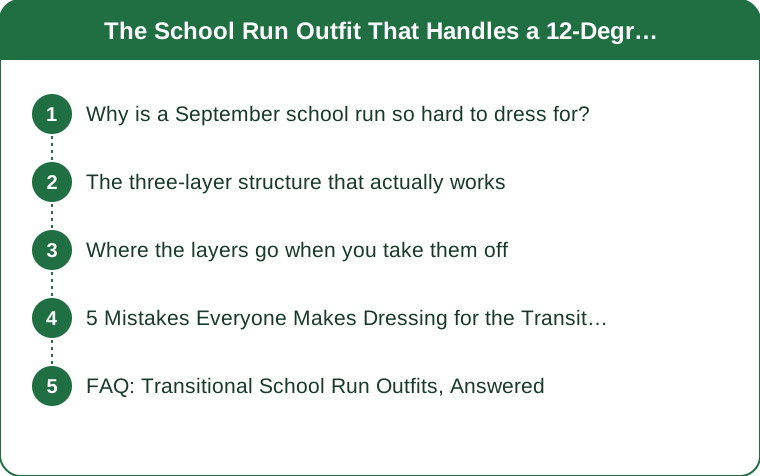
Why is a September school run so hard to dress for?
Because the daily temperature swing peaks in early autumn, and the two events sit at opposite ends of it.
Clear skies in September produce the widest daily range of the year. Without cloud cover, ground heat radiates away overnight, so mornings are genuinely cold. The same clear sky then allows strong daytime heating. A 12-degree swing between 8am and 3pm is completely normal.
What makes it worse than a similar swing in spring: in spring you dress for the cold and are pleased when it warms. In September you are still mentally in summer, so you dress for the afternoon and are cold for the first hour.
The two other complications specific to the school run:
- You are in and out of a heated car, which is a third temperature environment
- The morning involves activity - bags, doors, walking - and the afternoon often involves standing still at a gate, which feels several degrees colder for the same air temperature
The design brief, then: an outfit that works at 12 degrees while moving, at 24 degrees standing still, and inside a warm car, where the removed layers have to go somewhere other than your arms.
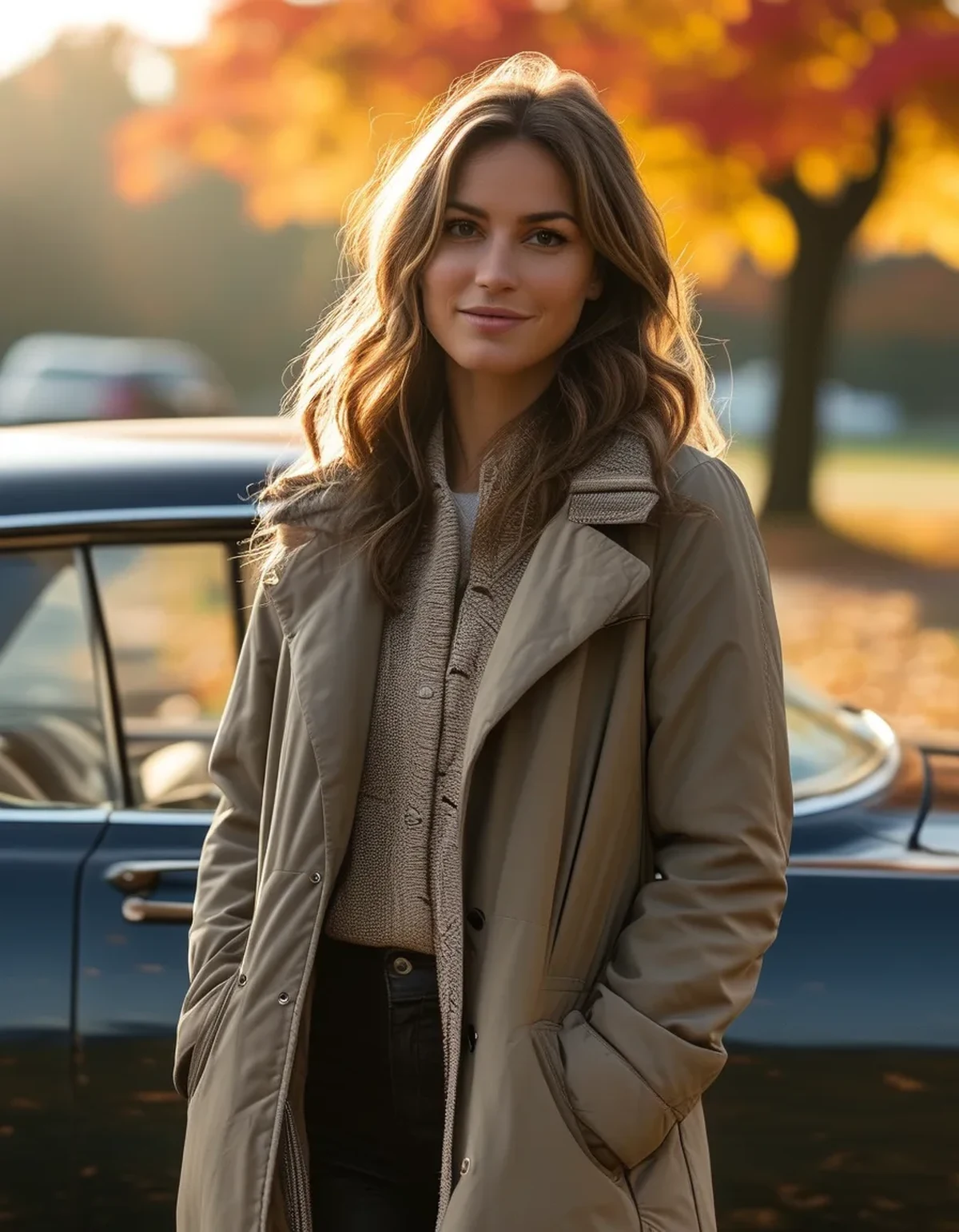
The single most useful principle: make the mid-layer the adjustable one, not the outer layer. Taking off a coat leaves you in whatever you were wearing underneath, which is usually not enough or too much. Taking off a cardigan leaves you in a considered outfit.
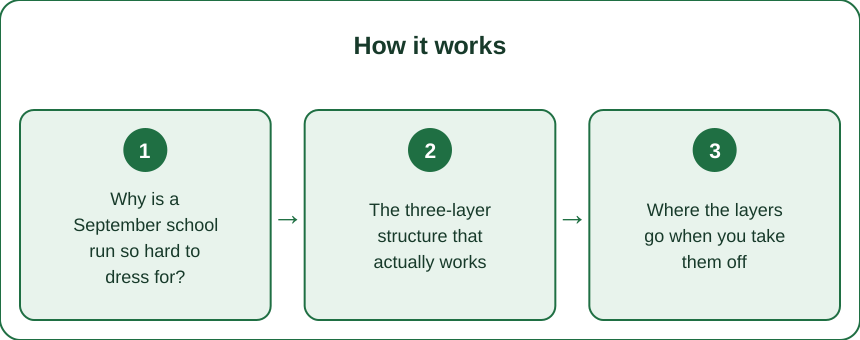
The three-layer structure that actually works
Layer 1 - the base, worn all day:
- A fitted long-sleeve top in a fine knit, jersey or light merino
- Long sleeves matter even for a warm afternoon, because they are what makes the mid-layer removable
- Choose a colour you are happy to be seen in alone, since it is the afternoon outfit
- Merino is worth the cost here specifically - it regulates across a wide range and does not hold odour, which matters for a garment worn from 7am to 6pm
Layer 2 - the workhorse mid-layer:
- An open cardigan, an overshirt, or a light zip-through - it must open without going over your head
- This is the layer you adjust ten times a day, so it needs to come off one-handed while holding a bag
- It should look intentional worn open, which rules out most jumpers
- Longline shapes work well because they cover the gap when you bend, reach, and load a car
Layer 3 - outerwear for the first hour only:
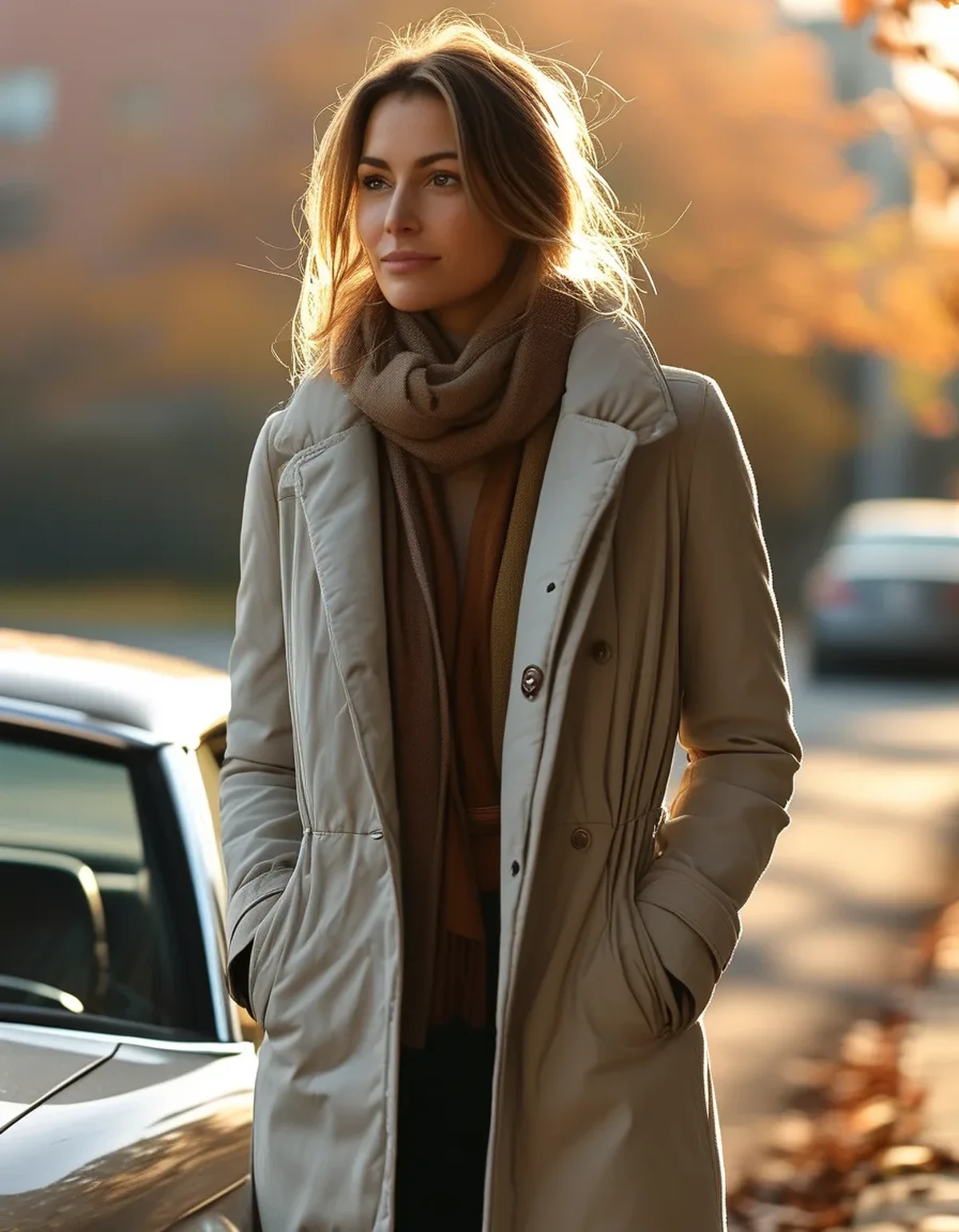
- A light quilted jacket, gilet or unlined trench
- The key requirement is that it packs down or hangs on a car hook without ceremony
- A gilet is genuinely underrated here - it warms the core in the morning and takes almost no space in the car afterwards
Bottom half, which people over-think:
- Full-length or 7/8 leggings, straight jeans, or wide trousers all work
- The lower half rarely needs adjusting, because legs tolerate the swing far better than the core does
- A crew sock and a substantial trainer closes the ankle for the cold morning and does not look wrong at 3pm
Where the layers go when you take them off
The unglamorous logistics problem that decides whether the system actually works.
In the car:
- A dedicated hook or a specific seat-back pocket for the removed layer, so it does not migrate to the boot and vanish
- A small tote that lives in the car for the jacket and anything else shed during the day
- The rule that makes it stick: the layer goes to the same place every time. A system with a fixed location survives; one that requires a decision does not.
When walking:
- A jacket that ties at the waist without looking odd - a light unlined jacket does, a quilted one generally does not
- A tote with a flat base that stands up rather than a bag that needs holding
- Crossbody over shoulder, so both hands stay free
On the standing-at-the-gate problem specifically: pickup involves standing still in the open for 10 to 15 minutes, often in wind. Standing still at 18 degrees feels colder than walking at 14. This is why people who dressed correctly in the morning are still cold in the afternoon.
- Keep the gilet or a scarf in the car for pickup, even on warm afternoons
- A scarf is the highest-return item for its size - it closes the neck, which is where standing-still cold registers first
The overall test for the outfit: could you take the mid-layer off, hold two bags, and still look like you got dressed on purpose? If yes, the system works. If the removal leaves you in a vest, it does not.
5 Mistakes Everyone Makes Dressing for the Transitional School Run
Mistake 1: One heavy garment with no middle setting. A big jumper over a tee is warm or not warm, and nothing in between. The whole point of the three-layer structure is having a setting between ‘coat’ and ‘cold’.
Mistake 2: A short-sleeve base layer. It feels sensible for the afternoon and it means removing the mid-layer is not an option at 11am. Long sleeves on the base layer are what make the middle layer adjustable.
Mistake 3: Dressing for the car. The car is heated and it is five minutes of a seven-hour day. Dress for the coldest thing you will stand still in, which is almost always the gate.
Mistake 4: Ignoring the ankle and the neck. These are the two places where cold registers fastest for the least fabric. A crew sock and a scarf outperform an extra jumper for morning comfort, and neither is a problem at 3pm.
Mistake 5 - the one that quietly ruins the system: no fixed home for the removed layer. Layers that end up in the boot, at school, or in a shop are layers you will not have tomorrow. One hook, one bag, same place every day.
FAQ: Transitional School Run Outfits, Answered
What is the single best item for September mornings?
A light gilet. It warms the core when it matters, takes no space in the car, and does not look wrong when the afternoon turns warm.
How do I stop being cold at pickup when the morning outfit was fine?
You are standing still rather than moving. Keep a scarf or gilet in the car specifically for pickup - the neck is where standing-still cold registers first.
Should I wear full-length or cropped leggings?
Either works. Legs handle the temperature swing far better than the core, so put the effort into layering above the waist and close the ankle with a crew sock.
What mid-layer works best?
Something that opens - a cardigan, overshirt or zip-through. Anything you have to pull over your head is not a layer you will actually adjust.
Is merino worth it for this?
For the base layer specifically, yes. It handles a wide temperature range and does not hold odour over a long day, which matters more than it does for a two-hour garment.
TL;DR:
- The daily temperature swing peaks in early autumn, and drop-off and pickup sit at opposite ends of it
- Three layers with an adjustable middle beats one heavy garment every time
- Long sleeves on the base layer are what make the mid-layer removable
- Standing still at pickup feels colder than walking in the morning - keep a scarf in the car
- Give the removed layer one fixed home, or you will not have it tomorrow
Dress for the gate, not for the car. Everything else about the transitional school run gets easier once the middle layer is doing the work.
See It in Motion
Seen here: High Waist Yoga Leggings with Inner Pocket — shop it on bubblelime.com
Keep Reading
This article is for general informational and styling purposes only. Fit, sizing, and product availability may vary.