Why One Arm Always Gets More Sun in the Carpool Line - and What to Wear About It

Quick Answer: Side windows in most cars block almost all UVB but only a fraction of UVA, and UVA is the wavelength that drives pigmentation and long-term skin ageing. In a pickup line you are stationary, facing one direction, for 15 to 30 minutes a day, so the sun lands on the same forearm, shoulder, and side of your face every single time. The fix is not sunscreen alone - it is a light long sleeve you keep in the car, sunglasses that actually cover the outer corner of the eye, and parking so the sun hits the passenger side instead of yours.
You notice it in late August. One forearm is a shade darker than the other, and you have not been on holiday.

Does car glass actually block UV?
Partly, and the part it does not block is the part that matters most for how skin looks over time.
Windscreens are laminated - two layers of glass bonded with a plastic interlayer - and that construction blocks the large majority of both UVB and UVA. This is why the front of a car is not the problem.
Side and rear windows are usually tempered, not laminated. Tempered glass blocks essentially all UVB but lets a substantial share of UVA through - studies of ordinary vehicle glass have found side windows transmitting anywhere from roughly 15 to 70 percent of UVA depending on the tint and the car.
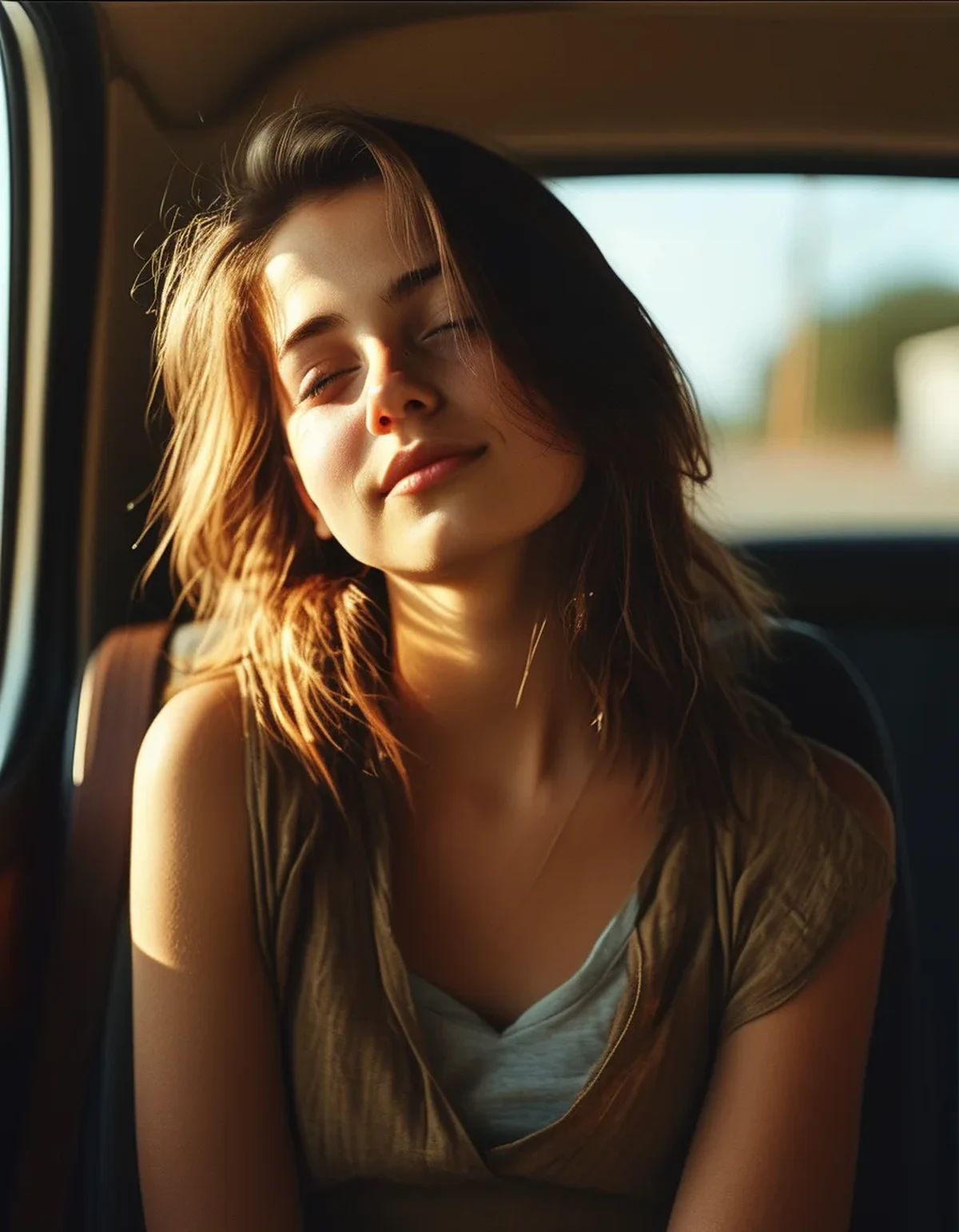
The practical consequence: you will not burn in the car, so you get no warning signal, but the pigmentation and collagen effects continue. Sunburn is a UVB phenomenon. The gradual darkening on one forearm, the freckling on one cheekbone, the finer texture change on the left side of the neck - those are UVA.
Why the pickup line is worse than driving. When you drive, your orientation changes constantly and the exposure averages out. When you sit in a queue for 20 minutes facing the same way, it does not. Add a school year of it and the arithmetic is not trivial: 20 minutes a day, five days a week, roughly 36 weeks, on one side.
Dermatologists have documented this pattern for decades in professional drivers, where the sun-side of the face shows visibly more photoageing than the other. The mechanism is identical in a stationary car.
What should you actually wear in the car?
The useful realisation is that fabric is a better UV filter than most people’s sunscreen habits, because fabric does not need reapplying and you cannot forget to put it on your left arm only.
The car sleeve. Keep one light long-sleeve layer permanently in the car - not in the house, in the car, because the whole point is that it is there when you did not plan ahead. What works:
- A loose, tightly woven cotton or linen shirt worn open over whatever you have on. Loose matters twice: airflow, and less fabric stretch, since stretched fabric lets more light through.
- A lightweight UPF layer if you want to be precise about it. UPF 50 fabric transmits about 2 percent of UV, which is a different order of protection than an unrated thin knit.
- Avoid a thin white stretched tee as your only barrier. A standard light cotton tee sits around UPF 5 to 8 when dry, and drops further when damp with sweat.
Sleeve length beats sleeve fabric. A three-quarter sleeve that ends mid-forearm protects exactly none of the part that gets the most sun. If you are going to bother, go to the wrist.
Sunglasses: check the outer corner. The skin at the outer corner of the eye and the top of the cheekbone is thin, gets hit at exactly the angle a side window allows, and is where crepiness shows up first. Narrow lenses leave that zone exposed. A wider or slightly wraparound frame covers the area that a small lens misses, and it is the single cheapest change on this list.
Shoes and the pedal foot. Minor, but if you drive in sandals with the window down, the top of the right foot takes sun for the same reason. It is why some people have a sandal-strap pattern that predates any actual beach day.
What Nobody Tells You About Everyday Car Sun
Cloud cover does not help as much as it feels like it does. UVA passes through light cloud with only modest reduction. The grey afternoon in the queue is doing more than the lack of glare suggests.
Window tint film is the actual fix, and it is not about darkness. Clear UV-blocking film blocks upward of 99 percent of UVA without changing how the glass looks. Most people assume tint means dark and legally restricted; the protective layer and the visible darkness are separate properties. Check local rules for front side windows, which are usually the regulated ones, and note that the rear passenger windows - where your children sit - are typically far less restricted.
Your left shoulder is the forgotten spot. People who do remember sunscreen apply it to the forearm and the face and skip the shoulder, which then gets exposed every time they wear a vest top or a wide neckline.
It is worse in autumn than in midsummer, for a geometry reason. As the sun sits lower in the sky, afternoon light comes in through the side window at a flatter angle - straight at you, rather than down onto the roof. The seasonal drop in intensity is partly offset by a much better angle of attack. September pickup is not a safe month.
Air conditioning masks it entirely. Heat is the sensation that normally makes you move out of the sun. In a cooled car, the feedback loop is broken - you feel comfortable while the exposure continues, which is precisely why nobody notices until the tan lines show up.
Parking direction is free. If the queue lets you choose, orient so the sun falls on the passenger side. Over a school year that is the highest-value zero-effort adjustment available.
How do you build this into an outfit that still looks like an outfit?
The failure mode is a good outfit plus an ugly emergency layer, which is why the layer ends up staying in the boot.
Pick the car layer as a deliberate wardrobe piece. One shirt, in a neutral that goes with most of what you wear - stone, soft white, navy, black - in a fabric that does not crease into a disaster after sitting folded on a seat. Linen blends crease; cotton poplin and lightweight tencel do not, and that is the whole decision.
Build the base for the car temperature, not the pavement temperature. The car is cold from air conditioning, the walk to the door is hot, and the classroom is somewhere in between. A sleeveless or short-sleeve base with the long shirt over it handles all three without a change of clothes.
Three combinations that work all week:
- Straight-leg leggings or slim trousers + fitted tank + open long shirt. The shirt does the sun work and the tidying-up work at the same time.
- A midi dress + the same shirt over the shoulders. Covers the arms, the shoulders, and the neckline in one move.
- Shorts + a longer-sleeve knit if the queue is short and the air conditioning is aggressive.
Sunscreen still has a job, and it is the face, neck, and the back of the hands on the wheel - the three places a sleeve cannot go. Applying it as the last step of your morning routine, before you leave, means it is on before the first drop-off rather than remembered at the second one.
Reapplication is unrealistic in a car and pretending otherwise is why the fabric approach wins. Choose the system that works when you are late and holding a coffee.
FAQ: Car Sun Exposure Questions, Answered
Do I really need sunscreen just to sit in a car?
For the face, neck, and hands, yes - those cannot be covered by a sleeve and they take the most cumulative exposure. For the arms, a sleeve is more reliable than sunscreen you will not reapply.
Does a darker tinted window mean more UV protection?
Not necessarily. Visible light transmission and UV transmission are different properties. A clear UV film can block far more UVA than a dark tint that was chosen for privacy. Ask specifically about UV rejection rather than shade percentage.
Is 20 minutes a day actually enough to matter?
On its own, no. Repeated on the same side of the body, five days a week, for years, it is exactly the kind of low-dose chronic exposure that photoageing research points to. The visible asymmetry that people notice is the evidence.
Does the windscreen protect my face while I am waiting?
While you are facing forward, largely yes. But in a queue you turn to talk to children, look out the side window, and check mirrors, and the side of the face is where the exposure lands.
What about the children in the back?
Rear side windows are often the least protected glass in the car and rear passengers sit against them for the whole journey. A clip-on shade or rear window film addresses that, and rear windows are usually the least legally restricted for tinting.
This is general information, not medical advice. If you notice a mole changing shape, colour, or size, have it looked at by a professional.
TL;DR:
- Side windows block UVB but leak UVA, so you never burn and never get the warning - while pigmentation and ageing continue.
- A stationary pickup queue concentrates the exposure on one forearm, one shoulder, and one side of the face, five days a week.
- Keep a loose long-sleeve shirt in the car, not in the house. A thin stretched tee is roughly UPF 5 to 8; a rated layer is 50.
- Wider sunglasses cover the outer eye corner and cheekbone that small lenses miss.
- Clear UV window film blocks over 99 percent of UVA without darkening the glass - and rear windows, where children sit, are usually the least restricted.
Autumn is not the safe season for this - a lower sun comes straight in through the side window. Put one shirt in the car this week and the whole problem quietly goes away.
Keep Reading
This article is for general informational and styling purposes only. Fit, sizing, and product availability may vary.